
How Far Is Considered a Long Distance Move? Why Distance Changes When You Should Book

By Tom Alten, Owner
The best time to book a long-distance move is outside the summer rush, and the farther you go, the earlier you should lock in a date. A long haul keeps a truck and crew committed for days rather than hours, and the busiest months leave fewer open slots. Distance also decides which rules apply to your move, and those rules shape how much lead time you need.
How far is considered a long distance move?
In California, a move of more than 100 constructive miles is a long-distance move, and any move that crosses a state line is an interstate move no matter how short. The California Bureau of Household Goods and Services classifies an in-state household move exceeding 100 constructive miles as long distance, which means it must be charged by weight and mileage rather than an hourly rate.
The flip side is that 100 constructive miles or less is a local move billed primarily on an hourly basis, as set out in the Maximum Rate Tariff 4. “Constructive miles” is the tariff’s own measure, so check the current tariff or ask your mover how your route is measured instead of relying only on a map app.
The second threshold is the state line. FMCSA says any move in which goods cross a state line is an interstate move, whether it is 10 miles or 2,000 miles, and it falls under federal licensing and safety rules rather than state regulation.
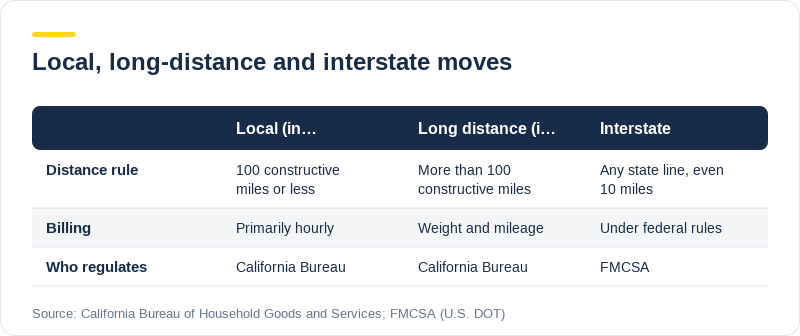
The 100-constructive-mile line and the state line decide how a move is classified and billed.
If you want the full picture of how this service works, see our long distance moving page.
When is the best time to schedule a long-distance move?
The best time is outside June, July and August, when mover availability is loosest. The U.S. Census Bureau reports that about 33 percent of all U.S. residential relocations happen in those three summer months, which tightens mover availability and fleet capacity significantly compared with winter.
It’s late November as we write this, so you are well outside that window. If your move is planned for next summer, the useful question is how early to commit, not whether to wait for a quieter month.
Long distance makes the timing more sensitive than a local move. A local job ties up a crew for part of a day. A long haul ties up the truck, the driver and the crew until the delivery is finished.
When are the busiest and quietest times to move?
The busiest stretch is Memorial Day to Labor Day, and the quietest is the winter months. The American Moving & Storage Association (now the ATA Moving & Storage Conference) estimates that about 60 to 70 percent of U.S. household moves occur in that peak summer season, as summarized by 10 Federal Storage. The Census Bureau’s June-to-August figure points the same way.
Volume is large all year. The Census Bureau’s American Community Survey put the national geographic mobility rate at 11.0 percent in 2024, or about 37,045,761 Americans who moved to a new home that year, according to a Bay Area Metro report. With that many households moving and most of them squeezed into one season, summer dates for long hauls go first.
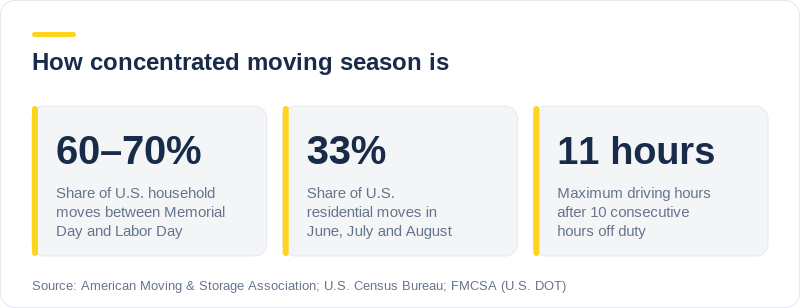
Most moves cluster in summer, and long hauls span several days of driving.
How far ahead should you book a long-distance move?
Book as soon as you know your destination and a target date, and earlier still if you want a summer slot. The research we rely on gives no official lead time, so treat any exact number of weeks with caution. Two rules explain why distance pushes the date earlier.
First, estimates take time. Under FMCSA regulation 49 CFR § 375.401, an interstate carrier located within a 50-mile radius of your origin must do an in-person or interactive virtual visual survey of your goods before giving a binding or non-binding written estimate. You need to schedule that survey and have your belongings roughly sorted before it happens.
Second, drivers can only drive so long. FMCSA hours-of-service rules in 49 CFR § 395.3 bar a commercial driver from driving more than 11 hours after 10 consecutive hours off duty. A long haul therefore spreads over several days, and delivery is often given as a window, so the truck is out of circulation longer.
Tip: Settle on your destination and a first-choice and a backup move date before you ask for estimates. A flexible date is the easiest way to avoid the summer crunch.
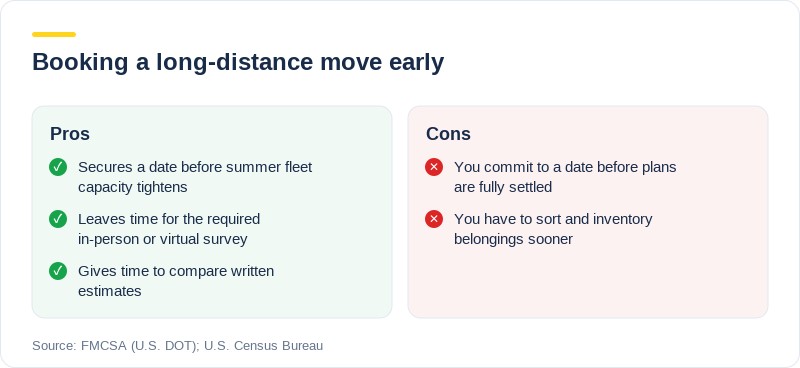
Early booking helps most when your date falls in the summer peak.
How does distance change the schedule and the paperwork?
Distance changes both how the job is priced and how long it takes. Inside California, a move over 100 constructive miles is billed by weight and mileage, so the mover needs a good picture of your inventory before quoting. Across a state line, federal rules apply instead of state rules.
For in-state moves, California law adds consumer protections. Under Business and Professions Code Sections 19225-19294, a commercial carrier moving household goods within California must hold an active CAL-T permit, carry mandatory cargo insurance and issue a written Not-To-Exceed estimate before loading, as outlined by Lorea AI. Confirm these items before you pick a date, not on moving day.
Two of our related guides go deeper on the schedule side. Read how travel time is billed on long-distance California moves for the cost question, or the Los Angeles to San Francisco timeline and route tips for a specific route.
What changes by season for Los Angeles moves?
In Los Angeles, the seasonal squeeze sits on top of a steady stream of people leaving the region. USAFacts, citing Census Bureau data, reports that about 661,200 people moved out of California to another state in the 2024 release, a net domestic loss of 254,300 residents, according to USAFacts. For the Los Angeles area specifically, Shilo AI cites Census and IRS figures of a domestic net outflow of 106,283 residents in the 2022-2023 filing cycle and 130,828 in 2025.
Those numbers mean out-of-state moves are common here, so don’t assume a quiet market for your dates.
Traffic matters for the first day. The INRIX 2025 Global Traffic Scorecard found Los Angeles-area drivers lost an average of 87 hours to congestion in 2025, ranking 4th most congested in the United States and 10th worldwide. A loaded truck leaving the LA basin has to get out through that traffic, so ask about departure timing.
Watch out: A mover that quotes an hourly rate for a California move of more than 100 constructive miles is not following the tariff classification described above. Ask how the move will be billed before you sign.
What if your move is under 100 constructive miles?
Then it is a local move, and the booking pressure is lighter. Prime Moving LLC’s listed local packages are 2 Movers & A Truck at $119, 3 Movers & A Truck at $149 and 4 Movers & A Truck at $199 (cash), with a 3-hour minimum. An additional mover is $40 and an additional truck is $50. See our local moving and pricing pages for what each package includes.
Frequently asked questions
How long of a drive is considered long-distance?
In California, a move is long distance when it exceeds 100 constructive miles. Crossing a state line makes it an interstate move regardless of distance. Because the tariff uses constructive miles, your actual drive time can differ from that measure.
What are red flags when hiring movers?
Watch for a mover with no active CAL-T permit, no written Not-To-Exceed estimate before loading, or an hourly rate quoted on a California move over 100 constructive miles. For interstate moves, be wary of an estimate given without any in-person or virtual survey of your goods. Prime Moving LLC lists CAL-T permit CAL-T0192547 and U.S. DOT number 3844145, and you should verify any mover’s numbers with the state Bureau and FMCSA.
How much is long-distance moving?
The research we use has no single price, because it depends on shipment weight and mileage. In California, moves over 100 constructive miles must be billed on those two factors, and the mover must give a written Not-To-Exceed estimate before loading. Get that estimate in writing and compare what it covers.
Is 40 miles a long-distance?
Not in California: an in-state move of 100 constructive miles or less is a local move billed primarily by the hour. The exception is a state line. If 40 miles takes you across one, it is an interstate move under federal rules.
If you’re planning a long-distance move and want to settle on dates, tell Prime Moving LLC where you’re going and when, and ask for a quote. You can reach us at (747) 222-0905, any day from 8 AM to 8 PM.
Related guides
- Do Movers Charge Double Drive Time? How Travel Time Is Billed on Long-Distance California Moves
- Moving from Los Angeles to San Francisco: Timeline, Costs, and Route Tips
Sources
- California Bureau of Household Goods and Services
- California Bureau of Household Goods and Services
- FMCSA (U.S. DOT)
- U.S. Census Bureau
- 10 Federal Storage
- Bay Area Metro
- FMCSA (U.S. DOT)
- FMCSA (U.S. DOT)
- Lorea AI
- USAFacts
- Shilo AI
- INRIX