
Do Movers Charge Double Drive Time? How Travel Time Is Billed on Long-Distance California Moves

By Tom Alten, Owner
Yes, but only on one kind of move. California’s tariff requires movers to bill double the actual driving time on hourly local moves, while moves over 100 constructive miles are priced by certified weight and mileage instead. If you are planning a long distance move from Los Angeles, double drive time usually isn’t the number to worry about. The written estimate is.
This guide explains where the rule applies, why Los Angeles traffic makes the drive-time line matter, and what to get in writing before you book.
Key numbers at a glance
- Under Item 320 of Maximum Rate Tariff 4, hourly moves in California must count billable travel time as double the actual driving time between pickup and drop-off, according to the California Bureau of Household Goods and Services.
- Moves over 100 constructive miles are long-distance moves and are charged on certified shipment weight and mileage, not hourly double drive time, as the Bureau’s consumer page explains.
- Los Angeles drivers lost an average of 88 hours to congestion in 2024 and 87 hours in 2025, ranking the region 4th most congested in the U.S., Roads & Bridges reports.
- Congestion cost the average Los Angeles driver $1,575 in 2024 and $1,602 in 2025, based on INRIX data summarized by Arash Law.
- Peak-period speeds across the metro averaged 21 miles per hour in 2024 and 24 miles per hour in 2025, per the same Arash Law summary.
What does double drive time actually mean on a local move?
It means the travel clock runs at twice the recorded driving time between your pickup address and your drop-off address. The rule comes from the state tariff, and the Bureau’s 2026 tariff applies it to hourly moves. Under California regulations effective in 2026, moves of 100 constructive miles or less count as local moves, where movers may bill by the hour and must include the double drive time rule.
The rule exists so travel is billed in a standard way. It does not mean a mover is padding your bill. It does mean the distance between your two addresses, and the traffic on the way, affects your total on any hourly move.
Two practical points follow:
- Ask how your mover measures the route and records the driving time. The tariff says actual driving time, so the method should be easy to explain.
- Ask whether the quote shows travel time as its own line or folds it into an hourly total. You want to see it either way.
Prime Moving LLC’s local moving work in the Los Angeles area is priced as hourly packages, covered in the pricing section below.
Does double drive time apply to a long-distance move?
No. Once a California move passes 100 constructive miles, the Bureau treats it as long-distance and charges it by certified shipment weight and mileage, according to the Bureau, not by hourly double drive time. A move that crosses the California state line is different again. It falls under federal interstate authority in 49 CFR Part 375, and California’s hourly double drive time rules cannot legally be used to bill it.
So a quote for a Los Angeles to Bay Area move should not be built on doubled travel hours. If one is, ask the mover to explain which rule they are using and why. Our Los Angeles to San Francisco guide walks through the timeline and route for that corridor.
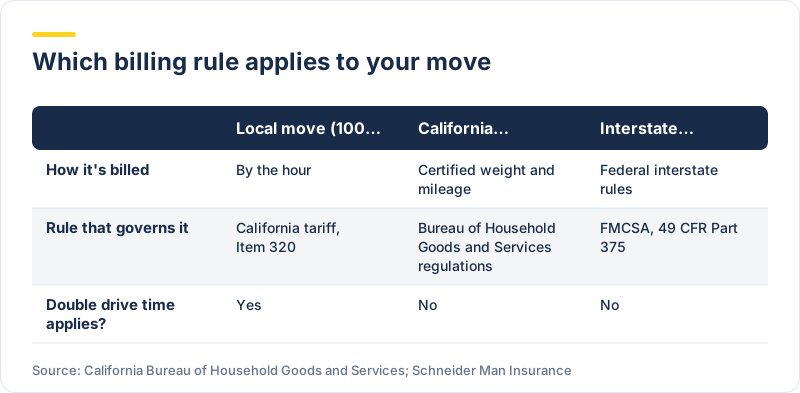
Double drive time applies only to hourly local moves, not to long-distance or interstate moves.
Watch out: If a long-distance quote lists hourly rates plus doubled travel time, ask which regulation applies. Weight-and-mileage pricing and hourly pricing are different systems, and you should know which one is on your estimate.
Why does Los Angeles traffic matter for the drive-time line?
Because on a local hourly move, slower driving means more recorded driving time. INRIX data shows peak-period speeds in the Los Angeles area averaged 21 miles per hour in 2024 before edging up to 24 miles per hour in 2025, which is the kind of pace that stretches out billable driving windows on local moves.
The wider picture explains why. The INRIX 2025 Global Traffic Scorecard shows Los Angeles drivers lost an average of 87 hours to congestion in 2025, costing $1,602 per motorist, with peak speeds at 24 miles per hour. Those dollar figures describe wasted time and fuel for ordinary drivers, not moving bills. They still show that time on the road has a real price here.
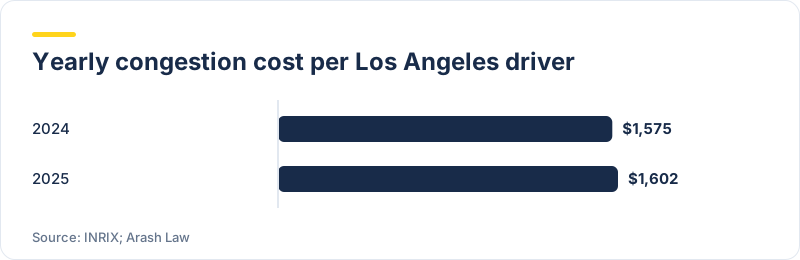
Wasted time and fuel per driver rose from 2024 to 2025, a sign of how costly road time is in Los Angeles.
What this means for you:
- A short hop between two nearby addresses can still cost more than you expect if it crosses town at a congested time.
- Moves between neighboring areas, such as Glendale to Pasadena, tend to carry less drive time than moves across the basin. Prime Moving serves Los Angeles, Glendale, Pasadena, Santa Monica, Long Beach, Beverly Hills, West Hollywood and Orange County.
- When you request a quote, give both full addresses and your preferred start time so the mover can estimate the drive realistically.
What else goes into the price, and what should be in writing?
Hourly labor, truck charges and extras make up the rest of an hourly quote, and the written agreement should show all of them. Prime Moving’s Los Angeles price list shows three packages, all with a 3-hour minimum:
- 2 Movers & A Truck: $129 (cash)
- 3 Movers & A Truck: $149 (cash)
- 4 Movers & A Truck: $189 (cash)
An additional mover is listed at $40 and an additional truck at $50. The Los Angeles list also shows a $69 truck fee. These are Prime Moving’s own listed prices, so ask for the current version and how travel time is handled on your route when you request a quote. On its Boston price list, Prime Moving shows a one-time travel fee that varies by distance, a reminder that travel charges take different forms in different markets. You can see the full structure on the pricing page.
Labor is the main cost behind any hourly rate. The Bureau of Labor Statistics counted 126,620 hand material and freight movers in the Los Angeles-Long Beach-Anaheim area, earning a mean hourly wage of $19.80. That is what workers earn, not what customers pay, but it shows how large and competitive the local labor market is.
What protections do you get on paper?
Before work begins, California movers must give you a written Agreement for Moving Services with a binding Not to Exceed Price. Under the tariff, your liability is capped at 100% of the estimate unless you sign a Change Order. If a crew member asks you to approve extra charges on moving day, that is the document they should be putting in front of you.
Any commercial household mover operating in California must also hold an active Cal-T permit from the Bureau, according to Schneider Man Insurance. Ask for the permit number and verify it with the Bureau before you pay a deposit.
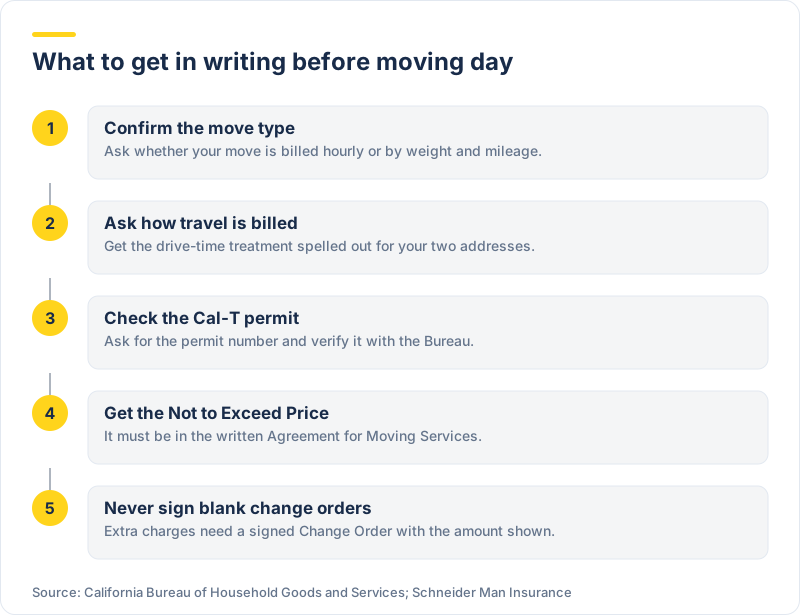
Five checks that protect you whether your move is billed hourly or by weight and mileage.
Tip: Photograph or save your signed agreement before the truck arrives. If a number changes later, you can compare it line by line.
How can you keep drive-time charges under control?
You can’t change the double drive time rule, but you can control what feeds into it. These steps help on local moves:
- Get both addresses right. Give the full pickup and drop-off addresses, including any stop for storage or a second pickup, so the estimate reflects the real route.
- Reserve curb space early. The City of Los Angeles asks residents to submit Temporary No Parking sign requests at least 10 business days in advance to reserve curbside parking for a moving truck. A crew circling for parking is time you don’t want to pay for. Check the current LADOT rules for your street.
- Be ready at the start time. Hourly clocks run whether or not boxes are ready. Our packing and unpacking help is one way to cut the time spent on the job.
- Consider the move type. If your destination is far enough to pass 100 constructive miles, ask for a weight-and-mileage quote instead of an hourly one.
- Compare written quotes, not phone totals. Check that each includes the Not to Exceed Price, travel treatment and any extras.
Frequently asked questions
Is double drive time legal in California?
Yes. Item 320 of Maximum Rate Tariff 4 requires movers on hourly California moves to calculate billable travel time as double the actual driving time between your origin and destination. It applies to local moves of 100 constructive miles or less, according to the Bureau.
Do movers charge double drive time on a move from Los Angeles to San Francisco?
No, not under California’s rules. A move over 100 constructive miles within California is charged by certified shipment weight and mileage. If you cross the state line, federal interstate rules apply instead.
Can the final bill be higher than the estimate?
Not without your signature. The written agreement must carry a binding Not to Exceed Price, which caps your liability at 100% of the estimate unless you sign a Change Order. If a mover asks for more on moving day, ask to see the Change Order before you agree.
What is Prime Moving’s minimum for a Los Angeles move?
Prime Moving’s Los Angeles price list shows a 3-hour minimum, with packages at $129, $149 and $189 for two, three and four movers plus a truck, listed as cash prices. A $69 truck fee and $40 per additional mover are also listed. Ask for a written quote that shows how travel is treated for your addresses.
Get a clear quote before you commit
If you’re weighing an hourly local move against a long-distance one, Prime Moving LLC can walk you through how your route would be priced and put the details in a written quote. Share your pickup and drop-off addresses and your preferred date, and we’ll go through the numbers with you.
Related guides
Sources
- California Bureau of Household Goods and Services
- California Bureau of Household Goods and Services
- Roads & Bridges
- Arash Law
- Schneider Man Insurance
- INRIX
- U.S. Bureau of Labor Statistics
- City of Los Angeles (MyLA311)