
How Much Does Office Moving Cost in Los Angeles? (2026 Guide)

Calculating an office moving cost in Los Angeles depends heavily on your team’s square footage, building freight elevator access, and the crew size required to safely relocate your equipment. While smaller suites can often relocate within a single day for a few thousand dollars, mid-sized and large commercial facilities require detailed project scheduling to control transit times and building compliance fees.
Key numbers at a glance
- $5,000: The average office move cost nationally, with small 1,000-square-foot spaces ranging between $750 and $4,000, according to Cubicle By Design.
- $188/sq ft: The average Los Angeles commercial office buildout and fit-out cost in 2026, reported by Keyz Commercial Real Estate.
- 88 hours: The average time lost to traffic congestion per driver across the metro area, according to the INRIX 2024 Global Traffic Scorecard.
- $18.42/hour: The mandatory minimum wage floor in the City of Los Angeles effective July 1, 2026, based on the City of Los Angeles wage notice.
- $1,000,000 to $5,000,000: The standard commercial general liability coverage required on Certificates of Insurance by major Class A high-rises, per City of Baldwin Park records.
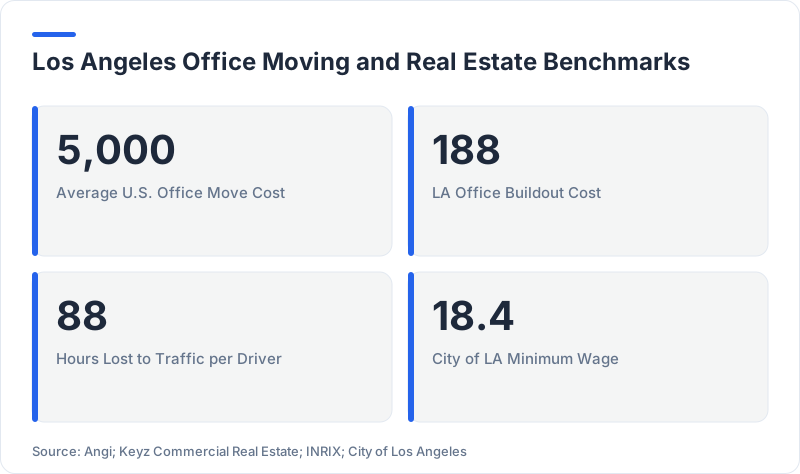
Key benchmarks shaping commercial moving budgets, labor rates, and traffic transit across the Los Angeles metropolitan area.
Estimating commercial moving expenses by office size
Commercial space requirements dictate both the vehicle capacity and the labor hours necessary to wrap workstations, transport servers, and organize filing systems. Nationally, facilities larger than 10,000 square feet routinely see moving quotes exceeding $30,000, as reported by Cubicle By Design. For standard commercial suites in Southern California, understanding these benchmarks prevents unexpected budget overruns.
At Prime Moving LLC, local rates are built on straightforward hourly tiers. A team of 2 movers and a truck starts at $119 per hour (cash rate), while 3 movers and a truck is $149 per hour, and 4 movers with a truck is $189 per hour. All Los Angeles packages carry a 3-hour minimum and a $69 truck fee. If your inventory involves expansive departmental layouts, additional movers can be added for $40 per hour and extra trucks for $50 per hour. Every package includes unlimited shrink wrap, unlimited tape, and the use of wardrobe boxes and protective moving blankets.
When budgeting for workplace changes, fit-out investments must also be taken into account alongside transit labor. Keyz Commercial Real Estate reports that LA office fit-outs rose by an annual increase of $26 per square foot to reach $188 per square foot in 2026. Furthermore, broader North American office fit-outs analyzed by JLL average between $280 and $295 per square foot, placing Los Angeles right next to San Francisco and New York as one of the country’s costliest interior development markets. Planning your move alongside your tenant improvement schedule ensures you do not pay moving crews to hold inventory while waiting on contractor turnover.
Labor dynamics and local hourly crew costs
Moving a corporate footprint requires substantial physical labor, and regional payroll rules directly shape local moving company rates. Effective July 1, 2026, the baseline minimum wage for workers in the City of Los Angeles is $18.42 per hour under the municipal code, according to GovDocs. For businesses operating in unincorporated pockets of the county, the Los Angeles County Department of Consumer and Business Affairs set the minimum wage at $18.47 per hour effective July 1, 2026.
Specialized logistics wages in Southern California trend above general wage minimums. Employment data published by the U.S. Bureau of Labor Statistics indicates that 128,800 laborers and freight, stock, and material movers worked in the Los Angeles-Long Beach-Anaheim metropolitan area in May 2024, earning an average mean hourly wage of $20.38 (or a mean hourly wage of $19.80, representing $41,190 annually, under occupational code 53-7062). The region holds the second-largest metropolitan workforce in the United States for material and freight movers, reflecting massive demand across corporate centers.
Using an experienced team for commercial moving helps prevent downtime and ensures delicate machinery, modular furniture, and IT equipment are protected. Professional crews with dedicated equipment speed up the physical haul so your employees can resume normal operations faster.
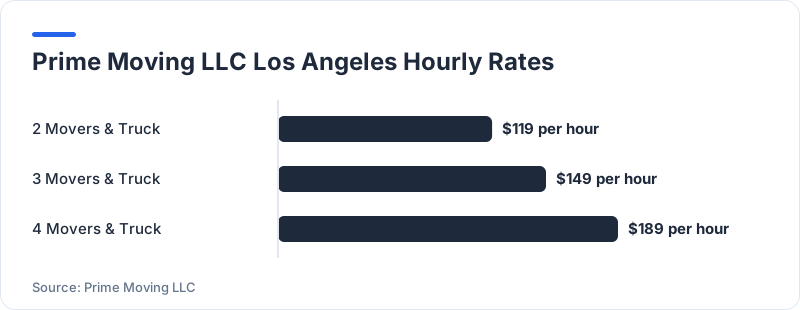
Standard hourly moving rates by crew size in Los Angeles, excluding the $69 truck fee and 3-hour minimum.
Navigating building access, COIs, and street permits
Commercial property managers enforce strict access criteria to protect hallways, service elevators, and common lobbies. Commercial management standards tracked by the City of Baldwin Park show that Class A and high-rise office towers routinely require commercial movers to provide a Certificate of Insurance (COI) carrying between $1,000,000 and $5,000,000 in general commercial liability before dock or freight elevator access is granted. Securing this documentation well ahead of moving day avoids costly delays when your truck arrives at the bay.
Street parking and curb logistics present another challenge. For curbside loading access, temporary “No Parking” signs must be posted on the street at least 24 to 48 hours in advance to be legally enforceable by parking officers, according to CurbSwap. Neglecting curb access or parking at unauthorized times can bring stiff penalties. Anti-gridlock rules under the municipal code and LADOT strictly ban commercial curb parking and loading on designated major corridors during peak hours—generally 7:00 a.m. to 9:00 a.m. and 4:00 p.m. to 7:00 p.m.—subjecting violators to a $93 citation plus immediate vehicle towing, according to SpotAngels.
Traffic delays also factor into the billed hours for local moves. Data from PR Newswire on the INRIX scorecard notes that LA drivers lost an average of 88 hours to road congestion, ranking the metro area as the third most congested in the country. To keep labor expenses manageable, coordinate building access for early mornings or weekends when freight elevators and street corridors have fewer bottlenecks.
Commercial real estate shifts and tenant negotiation leverage
Evolving vacancy rates across Los Angeles present opportunities for commercial tenants to offset moving expenses during lease negotiations. Market research from Investment Property Group indicates that the overall office vacancy rate across Los Angeles reached 25.5% in the first quarter of 2026, with average direct asking rents landing at $4.13 per square foot per month on a full-service gross basis.
Certain submarkets show even higher vacancy figures. In Downtown Los Angeles, third-quarter 2025 market data from CBRE noted an overall vacancy rate of 33.3% and an overall availability rate of 36.8%. Countywide figures published by the Los Angeles Times showed a 24.2% office vacancy rate in 2025, pushing overall commercial availability beyond 29% when unleased sublease and shadow inventory are counted. High availability in areas like downtown Los Angeles gives companies leverage to ask prospective landlords for tenant improvement allowances, turnkey buildouts, or direct cash allowances to offset commercial moving fees.
Conversely, prime corridors maintain steady pricing. According to CBRE, Class A direct office vacancy in West Los Angeles dropped to 22.1% in late 2025, with asking lease rates holding at $5.68 per square foot per month on a full-service gross basis. Whether relocating near the coast or inland, budgeting accurately for both freight handling and space setup keeps your organization protected.
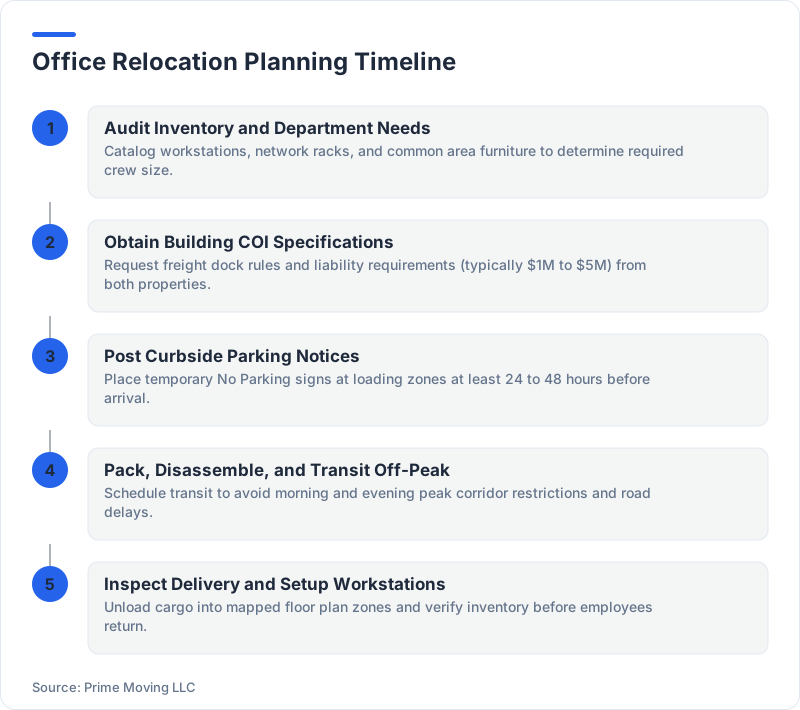
A practical step-by-step checklist for managing a smooth office move across Los Angeles.
Packing systems, liability, and inventory safety
Office relocations involve valuable assets such as copiers, monitors, modular desks, and executive suites. Preparing these items ahead of moving day prevents accidental damage and keeps crews moving efficiently. When utilizing full-service packing and unpacking, specialized crates and dollies are used to bundle computer setups and files without mixing up departments.
State moving regulations govern the default liability limits applied to commercial cargo. Under standard regulations from the California Department of Consumer Affairs and the Bureau of Household Goods and Services, standard basic released-value liability protection is legally established at 60 cents per pound per article at no extra charge, according to the California Department of Justice. This statutory baseline is capped at $0.60 per pound per item under intrastate rules documented by Moving Tariff. Because 60 cents per pound offers limited compensation for high-end server racks or high-density electronics, businesses with expensive equipment should check coverage levels and evaluate supplemental third-party cargo protection.
When moving substantial furniture assemblies, coordinating dedicated furniture moving services ensures your desks and conference tables are broken down, wrapped, and reassembled according to your architectural floor plan. Confirming all elevator dimensions and loading pathways in advance guarantees a seamless setup at your new site.
Frequently asked questions
How are hourly commercial moving rates billed in Los Angeles?
Commercial moves are typically billed using an hourly rate based on crew size, alongside travel time and equipment fees. At Prime Moving LLC, a 2-mover crew with a truck is $119 per hour, a 3-mover crew is $149 per hour, and a 4-mover crew is $189 per hour (cash rates), with each package subject to a 3-hour minimum and a $69 truck fee.
What basic insurance coverage comes standard on an office move in California?
Under California Bureau of Household Goods and Services regulations, intrastate carriers provide default Released Value Protection capped at 60 cents per pound per item at no additional charge. For expensive office tech and specialized machinery, commercial tenants often arrange third-party transit insurance for comprehensive financial coverage.
Why do downtown office towers require a Certificate of Insurance?
Property management firms require a Certificate of Insurance to shield their premises from potential damage to freight elevators, flooring, and docks during moving operations. Many Class A commercial buildings mandate proof of $1,000,000 to $5,000,000 in general commercial liability coverage prior to granting loading bay access.
How early should we post street parking signs for moving trucks in LA?
To reserve curbside space for commercial trucks, temporary “No Parking” signs must be posted on the street at least 24 to 48 hours before the job to be enforceable by local parking enforcement officers. Failing to post signs in advance can leave trucks with nowhere to park or risk anti-gridlock citations during rush hours.
Prime Moving LLC assists businesses throughout Los Angeles, Glendale, and surrounding areas with reliable commercial moving services. Reach out today to receive a personalized moving estimate tailored to your office’s inventory and layout.
Sources
- Cubicle By Design
- Keyz Commercial Real Estate
- INRIX
- City of Los Angeles
- City of Baldwin Park
- JLL
- GovDocs
- Los Angeles County
- U.S. Bureau of Labor Statistics
- CurbSwap
- SpotAngels
- PR Newswire
- Investment Property Group
- CBRE
- Los Angeles Times
- CBRE
- California Department of Justice
- Moving Tariff